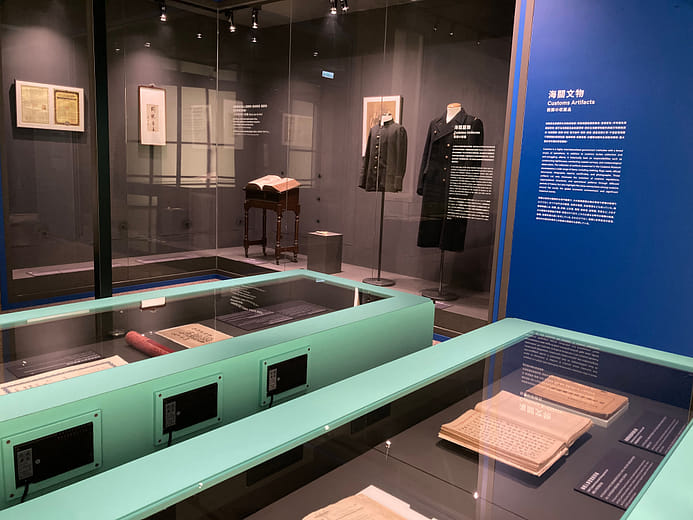
The “Taiwan Customs Boundary Stone” in the Customs Museum collection is made of granite and measures approximately 71 centimeters long, 29 centimeters wide, and 11 centimeters thick. It was discovered by Customs personnel in 1996. The discovery site was on the northern slope of the British Consulate at Takow, near the former residence of Qing dynasty Takow Customs officers.
In the Kaohsiung area, around Shaochuan Street and Anhai Street, five boundary stones engraved with “Taiwan Customs Boundary” have been uncovered to date. The inclusion of the characters meaning the boundary of land clearly emphasizes land ownership and sovereignty, formally declaring the land as belonging to and administered by Customs. In the Hengchun area, such as near Eluan Pi Lighthouse, three Qing dynasty Customs boundary stones have also been found. These bear only four characters “Taiwan Customs Boundary”, indicating a simpler administrative boundary. In locations like lighthouses, where land disputes were less complex, the shorter inscription was sufficient. The distinction reflects different purposes: “boundary of land” emphasizes exclusive land ownership and sovereignty, while “boundary” refers more generally to administrative limits.
This boundary stone is a crucial physical record for studying Qing dynasty Customs history, land ownership, and the development of modern administrative systems.