The First Wave of the Modern Theater Movement in Taiwan
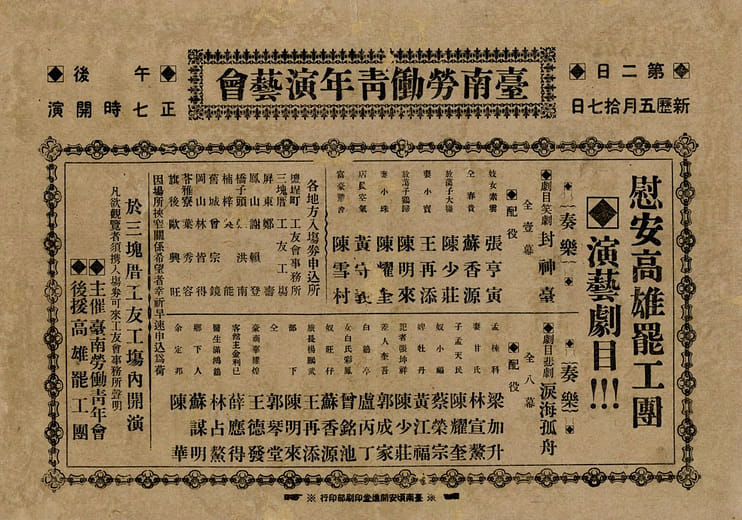
Traditional opera culture was once ubiquitous in the Han society of Taiwan, but in the process of colonial modernization, the emulation of drame bourgeois developed in the West during the 18th and 19th centuries, as they continued to distinguish a modern theater that belonged to contemporary Taiwan. The series of actions initiated by the Taiwanese in exploration of modern theater arts began with the Taiwan Cultural Association, which celebrates its centenary this year.
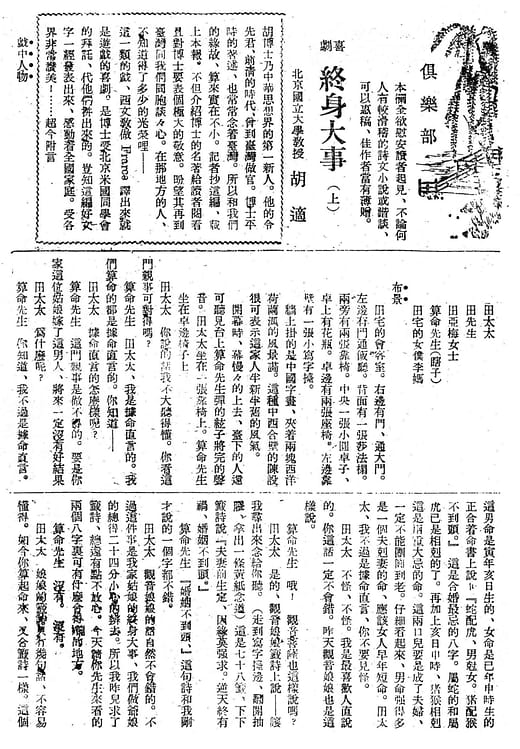
On the one hand, the Cultural Association’s decade long pursuit of new theater manifested in the emulation and appropriation of dramatic forms; on the other hand, this became a weapon for enlightenment and propaganda when merged with cultural and sociopolitical movements. Rooted in the experiences of the Cultural Association, dramatic theater in the 1930s developed a different path and style: Chang Wei-hsien led the Bîn-hong (Citizen’s Beacon) Theater Troupe and continued to toil as they embarked on a path of translating, adapting and performing world-renown works of realist masterpieces; Lai Ho and Yang Shou-yu began their experimentation with creating new operatic scores; while Yang Kuei devoted himself to introducing leftwing dramas in the publications he edited, and to systematize modern theater criticism.
Under the guidance of Wang Ching-chuan, a veteran of the Sin-ki̍k Movement, the Hiō-Sing Society for Theater Research emerged in the midst of wartime in 1943. The society invited Lin Tuan-chiu, who was among the first to be established in professional theater in Tokyo, to take charge of scriptwriting and direction. He created ambitious public performances at Hiō-Sing that brought together cultural elites across the disciplines of literature, drama, fine arts, and music. The play, Iam-Ke (The Capon), was a successful realization of “modern theater art” through the Gesamtkunstwerk concept, where the director brought together creativity from various artistic fields. The performance was regarded as “the dawning of Taiwan’s Sin-ki̍k Movement” for continuing in the pursuit by Taiwan’s dramatists for realism in the dramatic arts. After the war, Hiō-Sing began to branch out, and established the Jînkiok-tsō Theater Troupe and the Sìng-Hong Society for Theater Research in anticipation of further expanding the theater movement, but was abruptly interrupted by the February 28 Incident. The first wave of the modern theater movement in Taiwan thus came to an end. (Shih Wan-shun)