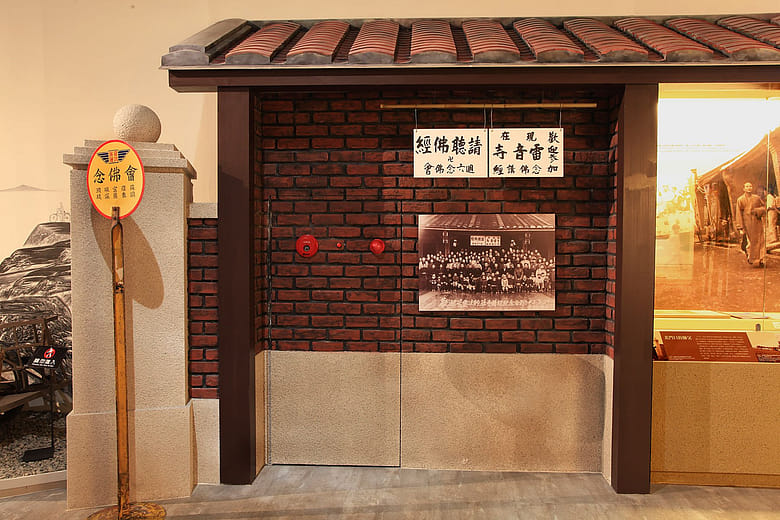
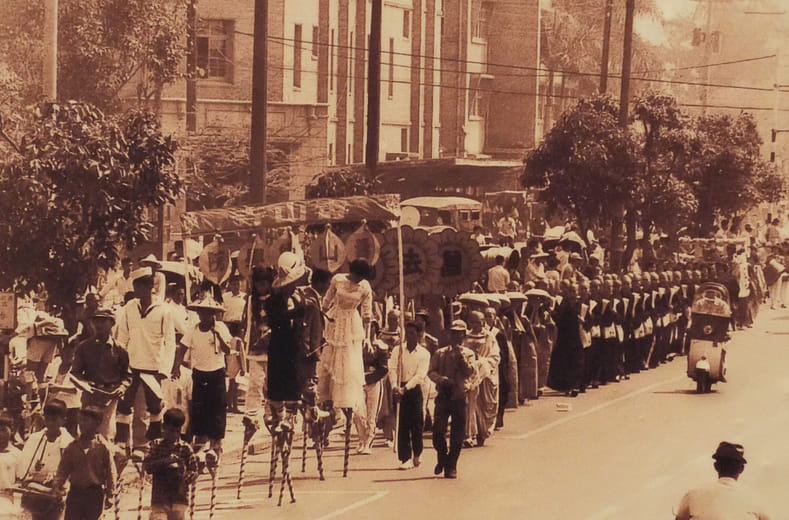
When Venerable Master Hsing Yun arrived in Taiwan in 1949, he was a stranger in a foreign land. In 1953, after becoming abbot of Lei Yin Temple in Yilan, in order to attract youth to Buddhism. Venerable Master formed the first Buddhist Youth Choir and made Buddhist recordings, completing six 10-inch records. Riding bicycles, he also led the youth to propagate the Dharma in towns and villages. Under such condions,
Venerable Master was inspired to write "Song of the Dharma Protector," which was widely accepted. He continued to write other Buddhist hymns, which include: "West," "Entreatment." "Song of the Gong," "Song of the Dharma Nectar." "The Great Buddha," "The
Song of Fo Guang Shan," and "The Song of Faith."
At the time, elderly Buddhist monks viewed Venerable Master's establishment of the Buddhist Choir as a departure from orthodox practice; believing that singing would lead to the destructon of Budshism, threatened to him. him. However,for the sake of propagating Humanistic Buddhism, Venerable Master never retreated, even if his own safety was at risk. Starting in 1979, he united traditional and modern culture by combining the singing of Buddhist hymns with dance and traditional Chinese music to propagate the Dharma in performances at the National
Sun Yat-sen Memorial Hall and the National Concert Hall. Later, he brought Buddhist hymn singing from the east to the west and pushed Buddhist music onto the international stage.