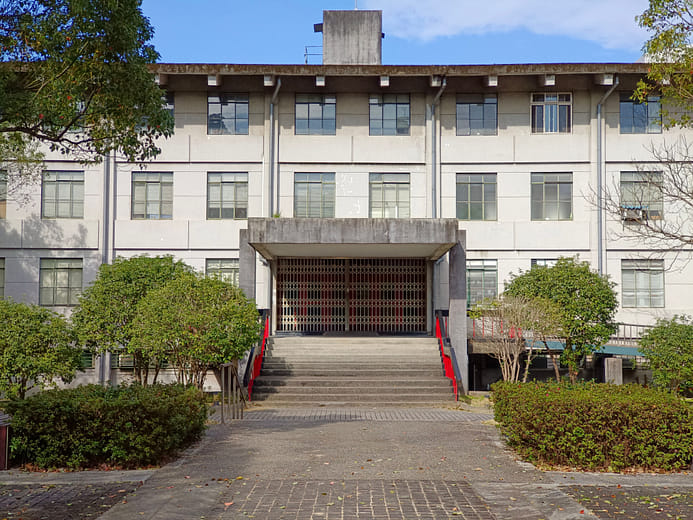
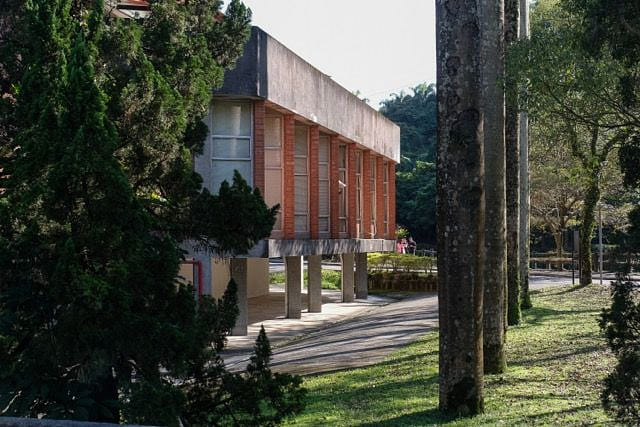
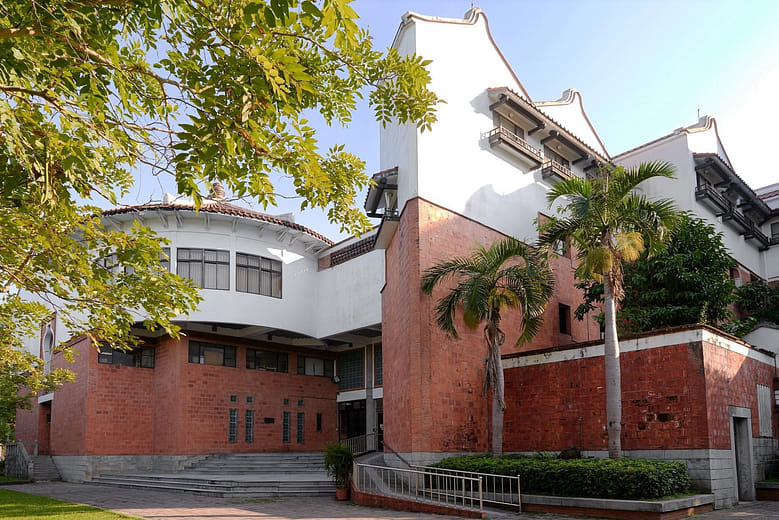
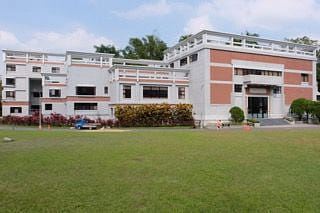
植物暨微生物學研究所大樓(1975、1985)Institute of Plant and Microbial Biology Building
王大閎 Da-Hong Wang
王大閎不僅是建築師,也是詩人與文學家,更是一個探索者,對太空有著無限想像。他為華人第一代最早接受西方現代建築洗禮的標竿性人物。他以現代主義的手法重新詮釋東方傳統文化的呈現。在戰後物資簡樸的年代,王大閎以簡潔的形式整合建築,並在細節處傾注心力,藉由樸素的材料展現建築之美。重要的公共建築作品有外交部、國父紀念館等。住宅的規劃設計亦極為出色。
王大閎在中央研究院區的建築作品,多為其建築生涯中晚期的作品。其特色在跳脫早期現代建築內外一致的嚴謹邏輯,而是將梁柱隱藏於皮層底下,形成立面較為自由的節奏,並不破壞原有的結構語法,但透過錯位表現自由的美感。
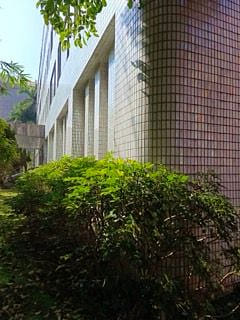
植微所舊棟是王大閎在南港院區的第一個作品,因空間不敷使用,1985年由王大閎於南側興建新棟並透過空橋連接。兩棟造型一致。建築以清水泥斬石子的灰與面磚的紅為主要色調,入口雨庇用兩道厚牆交接,強調入口位置。雨庇、牆體、包含主樓梯之轉折處皆採用圓角收邊。設計時間在王大閎構思登月紀念碑之後,故建築外牆垂直的遮陽板由下往上看,呈現如「萬箭齊發」的視覺效果,而轉角圓弧形的處理,也流露向太空致敬的況味。
Da-Hong Wang was an architect, poet, writer, and explorer with a vivid imagination about space. He was a pioneering figure among the first generation of Chinese architects to receive Western modern architectural training. He used modernist techniques to reinterpret the presentation of Eastern traditional culture. During the postwar era of material simplicity, Wang often integrated buildings into simple forms, focusing energy on details and using simple materials to create beauty. Important public architectural works include the Ministry of Foreign Affairs and the National Dr. Sun Yat-sen Memorial Hall.
Wang's architectural works at Academia Sinica belong to the later period of his career. Their characteristic lies in no longer adhering to early modern architecture's rigorous logic of interior-exterior consistency, but rather concealing beams and columns beneath surface layers, creating a freer facade rhythm. This approach does not break the original architectural vocabulary but expresses free aesthetics through displacement.
The building (old wing) was Wang's first work at the Nangang Campus. As the space became insufficient, the new wing, connected by a sky bridge, was constructed to the south in 1983 by Wang. The building features a primary color scheme of exposed concrete with chiseled aggregate in gray and red facing bricks. At the entrance, two thick intersecting walls highlight the entry point, while rounded edges are used on the canopy, wall, and staircase. The building was designed after Wang conceived SELENE, Monument to Man's Conquest of the Moon, the vertical sunshades of the building create a visual effect reminiscent of arrows shooting skyward when viewed from below. The curved corner treatments also pay homage to space.