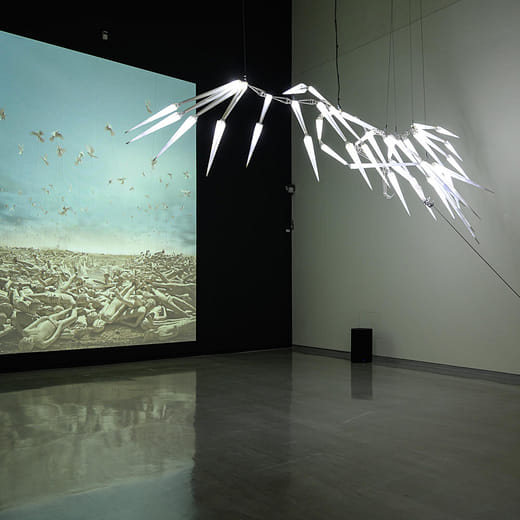
2016
4 min 28 sec
單頻道數位錄像 single-channel digital film
作品介紹:
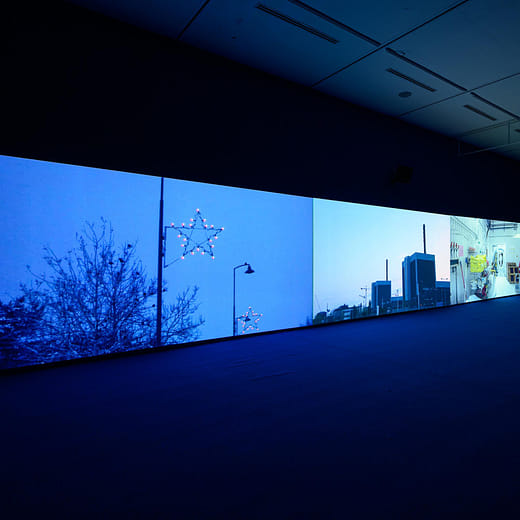
〈黑色粉末半島〉是創作計劃「消失的美學:沒有人民的國度」的第三章。這一系列的影片和錄像作品以中東、美國及英國的地景為主角。該計劃源自阿爾安妮對攝影、飛行及空戰對再現爭議地景的影響之三者關係的長期關注,誘發此系列的事件即為其出生地–伊拉克–在1991年的波灣戰爭中,受飛彈攻擊的媒體報導。
《黑色粉末半島》聚焦於英格蘭地景,為將注意力引向複雜的地理政治關係,作品不但與20 世紀後期美國軍事力量崛起有關,也連接了隸屬於大英帝國之美洲殖民地的歷史;以及英國在第一次世界大戰後,在現代中東地區的形成中所扮演的關鍵角色。
這件作品以空拍方式拍攝北肯特郡的胡半島,這個地區有著豐富的英國軍事遺跡和海軍、工業歷史,從16 世紀至1920 年初期,更是火藥的生產重地。影片名稱源自俗稱 「黑粉末」 的火藥,於13 世紀由中國傳入歐陸及中東地區。
《黑色粉末半島》 的拍攝及剪接手法營造出一種由地景升起及脫離地面的感受,彷彿從地面起飛,並將廢棄工業、軍事用地等特色留於原地。影片的垂直俯瞰視點形成地景扁平化、抽象化的效果,並進一步使地景陌生化,也揭示了隱身於視線中的歷史帝國廢墟。
藝術家介紹:
1966 年出生於伊拉克吉爾庫克,現居英國倫敦。
阿爾安妮的創作涵蓋攝影、電影及錄像。她畢業於柏亞姆肖藝術學校和倫敦皇家藝術學院,目前於倫敦藝術大學擔任攝影資深講師。阿爾安妮曾於國內外多次展出,並曾在倫敦海沃德美術館計劃空間、貝魯特藝術中心、華盛頓特區亞瑟.M.薩克勒美術館、倫敦帝國戰爭博物館、安曼Darat al Funun 藝術中心、以及倫敦泰德國英館 「藝術當下」 系列展中舉辦個展。
其近期展覽包括:「顫動的地景(」 荷蘭國家電影資料館,阿姆斯特丹);「行動劇場:波灣戰爭1991-2011(」 MoMA PS1,紐約);「縫合」(今日美術館,北京);「歸來吧,世界作為牢籠?」(國立二十一世紀當代美術館,羅馬);「影像作為地方」(舊金山現代美術館,舊金山);「誰詮釋世界?」(21 世紀當代美術館,金澤)。阿爾安妮曾參加 「第9 屆亞太三年展」、「第11 屆沙迦雙年展」、「第13 屆伊斯坦堡雙年展」、「第18 屆雪梨雙年展」 和 「第54 屆威尼斯雙年展」。其作品受多個機構收藏,包括:倫敦維多利亞與亞伯特博物館、波士頓美術館、華沙現代美術館、巴黎龐畢度中心、東京森美術館和維也納現代美術館等。
Work Statement:
The film Black Powder Peninsula forms the third chapter of the project The Aesthetics of Disappearance: A Land Without People, a series of film and video works featuring the landscapes of the Middle East, the United States and Britain. The project grew out of Al-Ani’s longstanding interest in the relationship between photography and flight and the impact of aerial warfare on the representation of contested landscapes, sparked by the media coverage of missile strikes on Iraq, her country of birth, during the Gulf War of 1991.
Focusing on the English landscape, Black Powder Peninsula draws attention to the complex geopolitical relations that link the rise of American military power in the second half of the 20th century with the history of the American colonies of the First British Empire and the pivotal role played by Britain in the formation of the modern Middle East in the aftermath of the First World War.
Shot from the air over the Hoo peninsula in north Kent, the film features an area rich with the remains of British military, naval and industrial history which was home to gunpowder production from the mid 16th century to the early 1920s. The f ilm takes its name from gunpowder, also known as black powder, which was introduced into Europe and the Middle East in the 13th century from China.
Black Powder Peninsula is shot and edited to create the sensation of rising up and out of the landscape, as if taking off and leaving behind the abandoned industrial and military sites featured. The film’s vertical aerial perspective has the effect of flattening and abstracting the landscape and rendering it unfamiliar while revealing the ruins of a faded empire hidden in plain sight.
Biography:
Born 1966 in Kirkuk, Iraq, and currently based in London, UK.
Al-Ani works with photography, film and video. A graduate of the Byam Shaw School of Art and the Royal College of Art, she is currently Senior Lecturer in Photography at the University of the Arts London. Exhibiting widely both nationally and internationally, Al-Ani has had solo exhibitions at the Hayward Gallery Project Space, London; Beirut Art Center, Beirut; Arthur M. Sackler Gallery, Washington DC;
Imperial War Museum, London; Darat al Funun, Amman; and Art Now: Tate Britain, London.
Recent group exhibitions include “Trembling Landscapes”, Eye Filmmuseum, Amsterdam; “Theater of Operations: The Gulf Wars 1991-2011”, MoMA PS1, New York; “A Stitch in Time”, Today Museum, Beijing; “Please Come Back. The World as Prison?” MAXXI, Rome; “Film as Place”, SFMOMA, San Francisco; “Who Interprets the World?”, 21st Century Museum of Contemporary Art, Kanazawa. Ali-Ani has participated in the 9th Asia Pacific Triennial; 11th Sharjah Biennial; 13th Istanbul Biennial; 18th Biennale of Sydney; and the 54th Venice Biennale. Her work can be found in collections including the V&A, London; Museum of Fine Arts, Boston; Museum of Modern Art, Warsaw; Centre Pompidou, Paris; Mori Art Museum, Tokyo; and Museum Moderner Kunst, Vienna.
攝影:ANPIS FOTO 王世邦。國立臺灣美術館提供。
Photographer: Anpis Wang. Courtesy of National Taiwan Museum of Fine Arts.